The Handloom Glossary: Kanjivaram, Banarasi, Jamdani, Tussar. What Actually Makes Them Different
Penned by Parihita Atelier
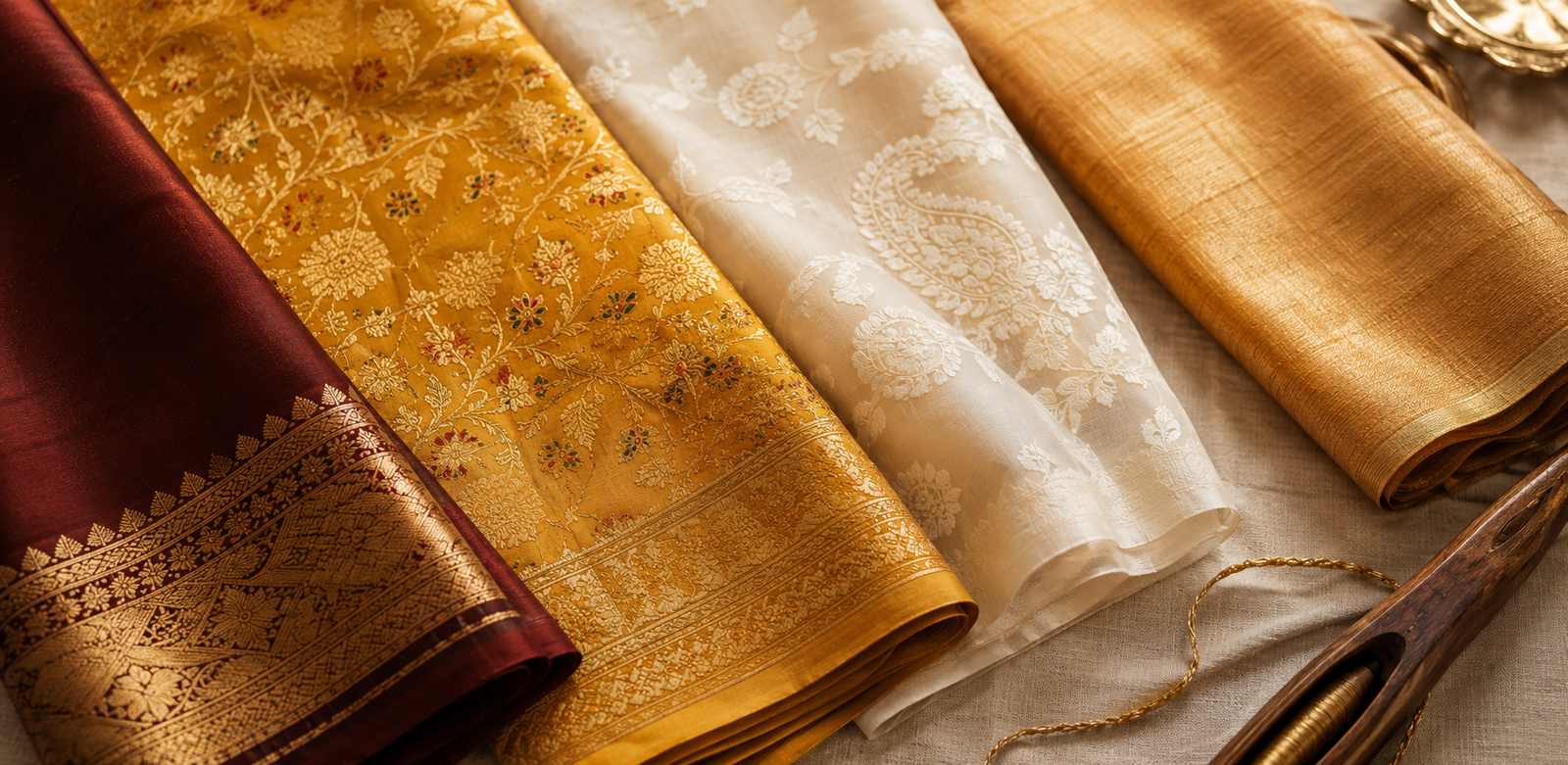
Every bride has said it at least once, standing in front of a saree she cannot look away from. "I love this. What is it called?" And more often than not, the answer she gets is a single word, borrowed from a salesperson who is in just as much of a hurry as she is. Banarasi. Kanjivaram. Something silk, something zari, something that costs what it costs because it is supposed to.
But a name is not the same as an understanding. And when you are commissioning a piece that will carry the memory of your wedding for the rest of your life, understanding matters more than the name on the label. This journal exists to close that gap, one weave at a time, so you can shop for your bridal saree with real confidence.
A Quick Comparison Before We Go Deeper
If you are short on time, here is how the four weaves stack up against each other. We will unpack each one in detail below.
| Weave | Origin | Signature Trait | Best Suited For | Typical Weight |
|---|---|---|---|---|
| Kanjivaram | Kanchipuram, Tamil Nadu | Interlocked korvai border, high sheen | Wedding ceremony, muhurat | Heavy |
| Banarasi | Varanasi, Uttar Pradesh | Brocade zari, Mughal motifs | Sangeet, reception | Medium to heavy |
| Jamdani | West Bengal | Hand added extra weft motifs | Mehendi, intimate functions | Light |
| Tussar | Central and Eastern India | Wild silk, golden matte texture | Haldi, daytime events | Light to medium |
Kanjivaram: The Weight of the South
Kanjivaram silk comes from the temple town of Kanchipuram in Tamil Nadu, and it announces itself before you even touch it. The fabric is heavier than most other silks, woven with a thicker thread that gives it a natural stiffness and a fall that holds its shape rather than clinging to the body.
What sets a true Kanjivaram apart is the korvai technique, where the body of the saree and its border are woven separately, often in contrasting colours, and then interlocked together on the loom itself. This is why a genuine Kanjivaram border does not fray or come undone even after decades of wear.
A few things worth knowing before you buy one:
- The zari used in an authentic Kanjivaram is traditionally silver wire dipped in gold, which is part of why older Kanjivarams retain resale and heirloom value.
- The pallu is usually woven in a contrasting colour to the body, a deliberate design choice rather than a limitation of the loom.
- A genuine korvai border will show a slight thickness or ridge where the two weaves meet. A printed or embroidered imitation will feel completely flat.
- Kanjivarams are traditionally heavier in the pallu and border, so brides who plan to wear one for several hours should ask their designer about pleating and pinning techniques that reduce strain on the shoulder.
This is why Kanjivarams remain the saree of choice for South Indian weddings, where the bride often needs to sit through hours of ceremony in one drape without the fabric losing its structure.
Banarasi: The Poetry of Varanasi
If Kanjivaram is architecture, Banarasi silk is poetry. Woven in and around Varanasi, this handloom saree is known for its intricate brocade work, often using zari made from real or metallic gold and silver threads, worked into motifs borrowed from Mughal art. Think flowering vines, paisleys, and jaal patterns that seem to float rather than sit on the fabric.
A genuine Banarasi is identified by a few consistent markers:
- The richness and density of the motifs, which should feel woven into the fabric rather than printed on top of it.
- A subtle raised texture when you run your fingers across the brocade sections.
- Zari that catches light without looking harsh or overly reflective, a sign of quality thread rather than synthetic substitute.
- Weight distribution that feels heavier toward the pallu and border, similar to Kanjivaram, but with a noticeably softer, more fluid drape.
This is a saree built for the moments that call for drama, a Sangeet, a reception, a family function where you want to be remembered. Because of the density of the brocade work, Banarasi sarees also photograph exceptionally well under both natural daylight and the warm indoor lighting common at Indian wedding venues.
Jamdani: The Discipline of Patience
Jamdani saree weaving is perhaps the most quietly demanding of all Indian weaves. Originating in Bengal, it involves adding extra weft threads by hand, motif by motif, directly during the weaving process rather than embroidering them on afterward. There is no shortcut here. A skilled weaver may spend an entire day completing just a few inches of a complex Jamdani pattern.
What makes Jamdani worth understanding before you buy:
- The base fabric is almost always a fine, sheer cotton or a cotton silk blend, which is part of why Jamdani sarees feel so light against the skin.
- Because every motif is added by hand during weaving, no two Jamdani sarees are ever truly identical, even within the same design family.
- The finest Jamdani work is judged by how evenly spaced and consistent the motifs remain across the entire length of the saree, a detail that separates a master weaver's piece from an apprentice's.
- Jamdani sarees are not meant for heavy embellishment. Their beauty lies in restraint, so brides looking for maximalist embroidery should consider it for one function rather than the main ceremony.
The result is a fabric so fine it can pass through a ring, yet strong enough to become an heirloom. If your dream is a saree that feels like air on your skin but carries generations of craft in every thread, Jamdani deserves your attention, particularly for a Mehendi or a smaller, more intimate gathering.
Tussar: The Wild, Warm Silk
Tussar silk has a story that starts in the forest rather than the farm. Unlike mulberry silk, Tussar is derived from silkworms that feed on wild trees such as saal and arjun, which gives the fabric its distinctive golden, earthy tone and its slightly textured, matte finish.
Points that help when evaluating Tussar:
- Its natural colour ranges from a pale honey to a deeper gold, and this base tone affects how dyed colours will ultimately appear, something worth discussing with your designer in advance.
- The texture is slightly coarse to the touch compared to mulberry silk, which is a mark of authenticity rather than a flaw.
- Tussar drapes with a softness that mulberry silk cannot match, making it comfortable for longer daytime functions.
- It takes dye beautifully, especially earthy and pastel tones, making it a favourite for brides who want a saree with warmth rather than shine.
Ideal for daytime functions, Haldi ceremonies, or a reception under soft evening light, Tussar has become increasingly popular with brides who want a handloom piece that feels less formal than Kanjivaram or Banarasi, without compromising on authenticity.
How to Tell a Genuine Handloom Saree From a Power Loom Imitation
This is the question we are asked most often at the atelier, and it deserves a clear answer.
- Check the reverse side of the fabric. Handloom weaves often show minor, natural irregularities in tension and thread placement. Power loom fabric tends to look mechanically uniform on both sides.
- Look at the border join. In handwoven sarees with techniques like korvai, you can usually feel a slight ridge or texture change where the border meets the body.
- Ask about the weaving time. A true Jamdani or fine Kanjivaram cannot be produced quickly. If a seller promises an intricate handloom piece within a day or two, that is worth questioning.
- Request provenance. A trustworthy atelier should be able to tell you which region or cluster of weavers a piece comes from, not just the fabric name.
Caring for Your Handloom Saree After the Wedding
A handloom saree is not a one-event purchase. Cared for correctly, a Kanjivaram or Banarasi can be worn for decades and eventually passed down. Here is what most brides are never told at the time of purchase.
- Dry clean handloom silks rather than washing them at home, especially pieces with real zari, since water can dull the metallic thread over time.
- Store sarees folded along different lines every few months. Repeated folding along the same crease weakens the fabric and can eventually cause tearing along the fold line.
- Wrap silk sarees in a soft cotton or muslin cloth rather than plastic. Plastic traps moisture and can cause yellowing over long storage periods, particularly in humid climates.
- Air out stored sarees once or twice a year, ideally in shade rather than direct sunlight, which can fade both colour and zari.
- For Jamdani and other lighter cotton weaves, gentle hand washing in cold water is usually safe, but always test on an inside corner first.
Getting this right means the saree you wear at your wedding can just as easily be the one your daughter wears at hers.
Matching the Weave to the Moment
One question we always ask during a consultation is simple. What is this saree actually for. The answer changes everything about weight, weave, and even colour palette.
- For the muhurat or main ceremony, where you are seated for hours and photographed constantly, a Kanjivaram or heavier Banarasi tends to hold its structure and its shine the longest.
- For the Sangeet, where movement matters more than stillness, a lighter Banarasi or a Tussar with strategic embellishment allows freedom without sacrificing richness.
- For the Haldi, where colour and comfort take priority over drama, Tussar's natural warmth and breathability make it an easy favourite.
- For a Mehendi or a smaller function with close family, a Jamdani lets you dress up without dressing loud, which many brides find is exactly the balance they are looking for.
Thinking in these terms, occasion first, weave second, tends to lead to far fewer regrets than choosing purely on first impression at a store.
Why This Knowledge Changes How You Shop
Here is the part most conversations skip. Knowing the difference between these weaves is not a trivia exercise. It changes how you evaluate price, how you choose a saree for a specific function, and how you communicate what you actually want when you sit down with a designer.
A bride who knows what korvai means will never be confused about why one Kanjivaram costs more than another with the same colour. A bride who understands Jamdani will know exactly why the process cannot be rushed, no matter how close the wedding date is. And a bride who understands Tussar's natural tone will make better decisions about which colours to choose for her Haldi outfit.
At Parihita, a bespoke bridal wear studio built on honest pricing, this is exactly the kind of conversation we want to have with you before a single thread is cut. Whether you are drawn to the temple grandeur of a Kanjivaram, the Mughal poetry of a Banarasi, the quiet discipline of a Jamdani, or the wild warmth of a Tussar, our atelier works with authentic handloom techniques to bring your specific vision to life, priced honestly, without the inflated markup of a luxury showroom.
You can browse pieces crafted in these very weaves in our collection, or if you already have a weave in mind and simply need it translated into your wedding vision, begin a consultation through our iDesign Studio, where the atelier comes to you, wherever you are. And if you would simply like to talk through which weave suits your wedding calendar before deciding on anything, our concierge is always the right place to start.
Spread the Heritage
Enchanted by this story?
Invite your inner circle to discover the world of bespoke luxury at Parihita.
Share on WhatsApp