Machine vs. Hand Embroidery: A Designer's Secret to Maximising Your Couture Budget
Penned by Kanika
There is a quiet anxiety that lives in the space between wanting something beautiful and being afraid to say what you can actually spend.
You open a designer's Instagram. The lehenga is breathtaking, deep ruby tissue silk, a pallu so dense with zardozi it could stand on its own. You screenshot it. Then you check the price and close the tab.
This is the story most brides never tell their designer. And it is the single biggest reason custom outfits so often disappoint — not because good design is impossible on a real budget, but because the designer never knew what the real budget was.
At Parihita, we built the iDesign Studio for exactly this reason. Not to up-sell. To listen, and then design backwards from your actual life.
But before we talk about the form, let us talk about the fabric. Specifically, the question that determines more about your final outfit's cost, and its photogenic impact, than almost any other decision you make: machine or hand embroidery?
The Real Difference Between Machine and Hand Embroidery — And Why It Is Not What You Think
Open any bridal forum and you will find the debate framed as a simple hierarchy: hand embroidery is authentic and precious; machine embroidery is a cheaper imitation. Buy hand if you can afford it; settle for machine if you cannot.
This framing is wrong. And it costs brides thousands of rupees every year.
The truth is more interesting.
What Machine Embroidery Actually Is
When fashion professionals say "machine embroidery," they are usually referring to computerised multi-needle embroidery systems; the same technology that produces the dense, precise threadwork on Banarasi brocade borders, on the fine floral fills of contemporary lehengas, and on the repeating geometric patterns of Lucknowi-inspired kurtas sold by every major designer label in India.
These machines can execute thousands of stitches per minute with microscopic consistency. The Indian textile industry; valued at over $223 billion, attributes 30–35% of its exports to embroidered products, with machine embroidery playing a central role. Surat, Bhagalpur, and Kolkata are global hubs for this craft precisely because the output is beautiful, durable, and scalable.
Machine embroidery is not a shortcut. It is a different tool — one that excels at:
- Dense, repeating motifs across large surface areas (skirts, borders, geometric fills)
- Absolute symmetry in patterns where the human eye would notice imperfection
- Metallic and zari threadwork that requires uniform tension
- High-volume production, which keeps unit costs down without sacrificing finish quality.
What Hand Embroidery Actually Gives You
Hand embroidery is slower, costlier, and, in the right application, irreplaceable.
The traditional crafts of India's embroidery vocabulary; zardozi (raised gold and silver wire work from Lucknow and Agra), chikankari (white-on-white shadow stitching), kantha (running stitch from Bengal), gota patti (applied ribbon work from Rajasthan), mirror work from Gujarat, are not just decorative techniques. They are recorded history, stitched by communities whose livelihoods depend on our continued demand for their work.
What hand embroidery gives you that a machine cannot replicate is character. The slight irregularity of a human stitch. The way zardozi petals catch candlelight differently because no two are at the same angle. The texture that only emerges when a piece has been held, turned, adjusted, and stitched by someone who has spent decades learning to read fabric.
Cameras love hand embroidery. Candlelight loves it. And for the pieces of a garment that will be seen up close, the neckline, the pallu focal panel, the cuffs and hems, hand work delivers a depth of visual richness that no machine has yet matched.
The Part Nobody Tells You
Here is the strategic insight that separates a well-designed custom outfit from an expensive disappointment: you do not need an entirely hand-embroidered garment to achieve a couture look.
The most visually stunning bridal outfits, the ones that stop a wedding hall, that photograph beautifully from every angle; that still feel special when you look at them twenty years later, are almost never entirely hand-embroidered or entirely machine-made. They are designed.
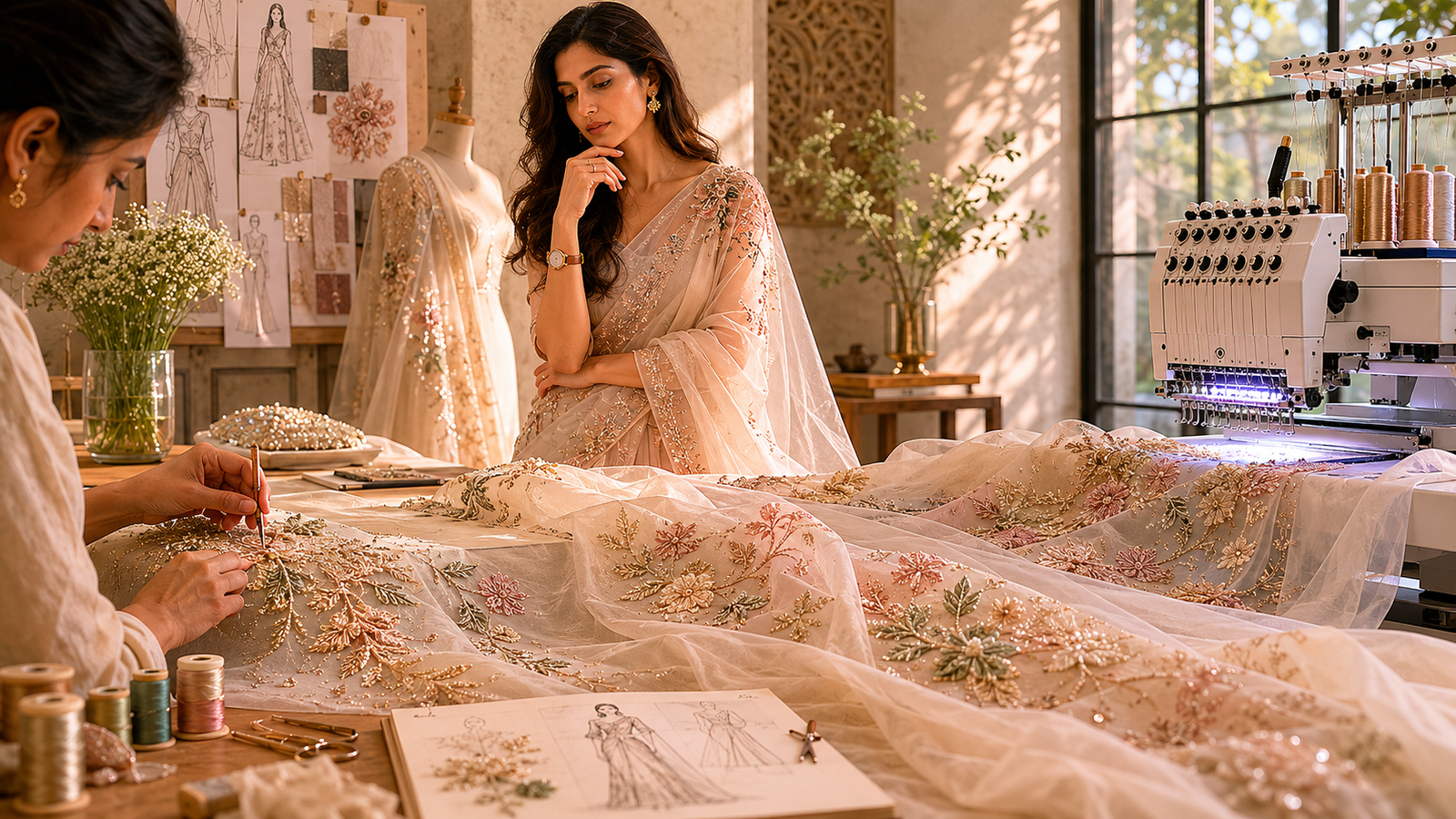
The base fabric might be a fine machine-embroidered tissue or organza, with a precisely placed hand-stitched pallu panel. The lehenga skirt might use a computer-embroidered jaal pattern that reads as luxurious from six feet away, while the bodice features custom zardozi worked by hand into a design specific to the bride. The dupatta might be machine-stitched across the body with a hand-knotted tassel border.
This is not compromise. This is couture thinking.
A Designer's Field Guide to the Machine-vs-Hand Decision
Here is a practical framework for thinking about where each technique belongs on a bridal outfit.
Zones Where Machine Embroidery Wins
Large surface area fills. The skirt of a lehenga, the body of a saree, the back panel of a sharara, these are zones where the eye reads pattern as texture rather than individual stitch. Machine embroidery creates beautiful, consistent texture across these surfaces at a fraction of the hand-labour cost. The photographic result is often identical.
Repeating geometric or symmetrical motifs. If the design requires a perfectly symmetrical buti or a precise diagonal jaal across 4 metres of fabric, machines are not just cheaper, they are better. Human hands, however skilled, introduce small variations that the repetitive nature of geometric patterns tends to amplify rather than hide.
High-density base work. The background fill of a heavily embroidered piece, the foundation that makes a zardozi focal point read as rich and opulent, is often machine-stitched. It is invisible in photographs, but removing it would make the hand work look sparse.
Production of multiple pieces. For families who want coordinated trousseau pieces, a set of sarees in consistent colourways, a mother-of-the-bride outfit that echoes the bridal lehenga, machine embroidery makes coordination achievable without tripling the budget.
Zones Where Hand Embroidery Is Suitable
The pallu. If you are wearing a saree, the pallu is the canvas. It is what drapes over your shoulder in photographs, what catches the light as you move, what people reach out to touch. A hand-embroidered pallu on a machine-embroidered saree body is the most intelligent budget allocation in bridal fashion.
The bodice and neckline. These are the zones closest to your face in portraits. The zones where guests look first when they greet you. Even a modest amount of hand work, a hand-stitched neckline, a band of kantha along the blouse hem often elevates the entire outfit.
Signature or personalised elements. A bespoke design element, a motif with personal meaning, a monogram, a custom pattern created specifically for your brief, almost always requires a human hand. Machines execute; artisans interpret.
Statement border work. A hand-embroidered border on a pure Banarasi or Chanderi saree announces itself. The dimensional quality of gota patti applied by hand, or a border of mirror work stitched individually, reads differently at close range than its machine-produced equivalent.
The Budget Allocation That Changes Everything
Think of your embroidery budget not as a single number but as a resource to allocate strategically across the garment.
A ₹1 lakh outfit that allocates ₹70,000 to a hand-embroidered pallu and bodice panel, with machine embroidery on the remaining body, will often look more impressive than a ₹1.5 lakh outfit where the budget is spread evenly and thinly across the entire surface.
This is the insight that professional designers apply every day. It is also the insight that most clients never have access to, because nobody sat down with them and explained it before the brief was written.
The Honesty Problem in Couture — And How Parihita Approaches It Differently
There is an unspoken performance that happens in most couture conversations. The client arrives hoping to sound aspirational. The designer quotes based on that aspiration. The numbers don't match. Several rounds of awkward negotiation follow, and the final design is usually a version of the original that has been quietly stripped of quality in ways the client may not notice until the wedding photographs arrive.
At Parihita, we have built our entire design intake process around a different assumption: that honest budget conversations produce better garments.
This is not idealism. It is craft logic.
When a designer knows your actual budget at the start, not the aspirational number, not the negotiating number, but the real one, they can make genuine decisions. Which fabrication technique to use on which zone. Where to invest in hand work and where to let a beautiful machine-embroidered ground cloth do the job beautifully. What silhouette will serve both the design vision and the material constraints.
The result is an outfit that was built to its budget with intention, rather than an outfit that had its quality quietly removed in service of a number nobody said out loud.
What the iDesign Studio Design Notes Section Is For
When you fill in the iDesign Studio questionnaire, you will find a section called Design Notes.
his is where you share the real brief. Not just the mood board images, measurements and the colour palette — but the occasions, the timeline, the honest budget range, and anything else that gives our team the full picture.
You might write: "Reception lehenga, ₹80,000–₹1.2 lakh, want hand embroidery on the bodice, happy to use machine embroidery for the skirt if it means we can afford the fabric quality I have in mind."
Or: "Custom saree for my sister's wedding. I am not the bride. Budget is ₹20,000 maximum, but I want it to look considered and not generic. Open to creative suggestions."
Or simply: "I have seen this reference image and want something in this direction. I have ₹45,000 and I do not know what is realistic. Please tell me."
Every one of these is a real brief that produces a real outcome — because the designer has what they need to work with. And because Parihita's position has always been that couture is a form of honest collaboration, not a one-directional pitch.
Frequently Asked Questions
Is machine embroidery lower quality than hand embroidery?
Not inherently. Modern computerised embroidery machines produce extremely fine, consistent work, and on large surface fills, the finish is often indistinguishable from hand work in photographs. The difference is not quality but character: hand embroidery carries the slight, irreplaceable irregularities of a human maker. Which is better depends entirely on what the design needs, and where on the garment it will be used.
Can I get a fully custom outfit made online in India?
Yes, this is precisely what Parihita's iDesign Studio is designed for. You complete a detailed questionnaire covering your occasion, silhouette preferences, fabric choices, embroidery style, measurements, and budget. The Parihita team reviews your brief and returns with a tailored design direction, fabric and embroidery recommendations, and a clear cost breakdown. The entire process, from first brief to final dispatch, is managed online.
How much does a custom made wedding dress or lehenga cost in India?
The range is genuinely wide. A bespoke lehenga using machine embroidery on the skirt and hand embroidery on the bodice typically begins around ₹40,000–₹80,000 for good-quality execution. A fully hand-embroidered couture piece in premium silk or tissue, with significant artisan time; starts at ₹1.5 lakh and can go much higher. The most important thing you can do is state your budget honestly. A good designer will tell you what is achievable within it; and a great designer will show you how to make it look like more. At Parihita, we do not forget the beautiful bridesmaids, cousins, mother and aunts as well and we often create masterpieces for them without burning a hole in the pocket.
What is gota patti embroidery and is it hand or machine made?
Gota patti is a traditional Rajasthani embroidery technique using applied ribbons of gold or silver metallic cloth, cut and folded into petals, leaves, and geometric shapes, then hand-stitched onto fabric. Authentic gota patti is always hand-applied, the folding and placement is too three-dimensional for machine execution. It is one of the most cost-effective ways to achieve a rich, festive look, particularly on dupattas and lehenga borders, because the material itself is relatively affordable and the design impact is significant.
How do I tell the difference between machine and hand embroidery on a saree?
Turn the garment over. Hand embroidery will show loose thread ends, slight inconsistencies in stitch length, and sometimes visible knotting at the back. Machine embroidery will be uniform on both sides, with no loose ends and perfectly consistent stitch spacing. On the front, look for slight variation in thread tension and tiny imperfections in symmetry, these are the signatures of a human hand, and they are generally considered desirable on fine pieces. It is quite similar to differentiating between lab grown and naturally found diamond.
How to Commission a Bespoke Indian Outfit That Looks Far More Expensive Than It Is: A Practical Checklist
Before you fill in any design brief, work through these decisions. The clearer your thinking at this stage, the better the output.
1. Define the occasion hierarchy. Is this the primary bridal outfit or a supporting function look? The budget allocation shifts significantly depending on where in the wedding schedule the outfit will appear.
2. Identify the hero zone. Every great outfit has one: the element that will be remembered, that will be front and centre in photographs. The pallu. The bodice. The dupatta border. Invest here. Economise everywhere else.
3. Be specific about fabric. Machine embroidery on pure georgette looks different from machine embroidery on tissue silk or organza. The base fabric is where quality differences are hardest to fake and where budget is often better spent than on additional embroidery.
4. Think about movement. Heavy hand embroidery on a full-volume skirt is magnificent but exhausting for a six-hour wedding. Consider whether you want to actually wear this outfit comfortably, or whether it is a visual statement piece that will be photographed and then changed.
5. State the real number. Not the number you think sounds appropriately ambitious. Not the number you are prepared to go up to if you are pushed. The number you actually have. The design that comes back will be better.
The Parihita Position on Couture and Budget
We believe couture is not a price point. It is a practice; the practice of designing something specifically for a specific person, with full knowledge of who they are, what they need, and what they have to work with.
A ₹60,000 outfit designed with intention, with the right allocation of machine and hand work, with a fabric choice that serves the silhouette, and with a clear brief at its centre, that is couture. It is more couture, in the truest sense, than a ₹3 lakh garment assembled by committee from a reference image and a vague budget number that nobody took seriously.
This is what we mean when we say: couture is an expression of self, not an exercise in overspending.
The iDesign Studio questionnaire exists to give your design brief the serious, honest foundation that makes this kind of work possible. The Design Notes section is yours to fill completely, your budget, your constraints, your questions, and your ideas. There are no wrong answers. There are only honest ones and vague ones, and honest ones make better outfits.
Couture is an expression of self, not an exercise in overspending.
Tell us your design notes and honest budget parameters through our studio questionnaire, and let us build your custom masterpiece.
Begin your iDesign Studio brief → parihita.co.in/idesign-studio
Spread the Heritage
Enchanted by this story?
Invite your inner circle to discover the world of bespoke luxury at Parihita.
Share on WhatsApp